
How We Reduced RBAC Verification Time by 90% in Clinical Imaging Software
Role-based access control (RBAC) is a foundational security mechanism in medical imaging software. Regulatory frameworks applicable to medical device software (including MDR, FDA 21 CFR Part 11, ISO 13485, and IEC 62304) impose requirements on access control, data integrity, and audit traceability that RBAC implementations are commonly used to satisfy 1,2. Ensuring that each user role can only access the features and data it is authorized to interact with is both a regulatory obligation and a patient safety imperative. However, as the number of roles, permissions, and platform features grows, the verification effort scales combinatorially — making exhaustive manual validation increasingly costly in terms of time and resources.
This article presents a configuration-driven, automatically generated test automation architecture for RBAC verification in clinical imaging platforms. The methodology reduced verification time by approximately 90% — from two working days to under 45 minutes — while maintaining the same exhaustive coverage of the entire permission matrix.
The RBAC Verification Problem in Clinical Imaging Platforms
In clinical imaging environments, access control operates across multiple orthogonal dimensions. A platform may define N distinct user roles, each with M individual permissions controlling visibility, editability, and navigability of platform features. The total verification space is therefore O(N × M), and each permission must be validated both positively (authorized users can perform the action) and negatively (unauthorized users cannot) 3.
The challenge is further compounded by hierarchical data scoping. Permissions are not only feature-level gates but also interact with data visibility tiers — a given role may have access to a feature but only for data within its organizational scope (e.g., site-level, project-level, or system-wide). This hierarchical scoping effectively adds a third dimension to the verification matrix, requiring that identical feature-level permissions be validated under different data context constraints.
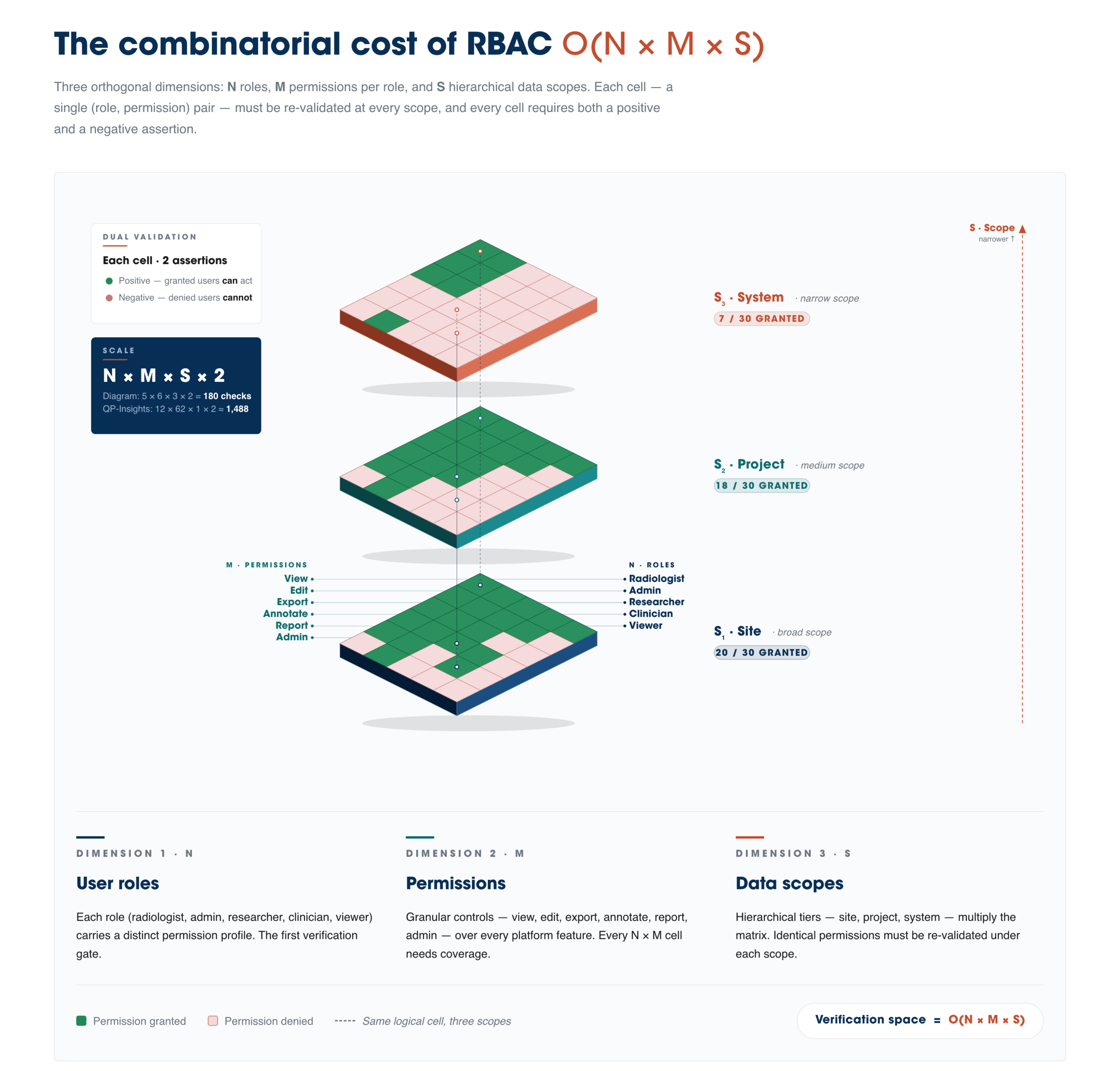
[Figure 1: The O(N × M × S) verification space]
Manual verification of this matrix requires a human tester to authenticate under each role, navigate to each feature, and assert the correct behavior for each permission. While this process achieves complete coverage, it presents inherent scalability constraints:
- Time cost: Exhaustive manual verification of the full RBAC permission matrix requires approximately two working days per cycle — time that scales linearly with the addition of new roles or permissions.
- Inter-tester variability: Different testers may interpret expected behavior differently or overlook subtle UI states (e.g., a button that is visible but disabled versus one that is hidden entirely).
- Execution frequency: The significant time investment limits how often exhaustive verification can be performed, typically constraining it to release milestones rather than every build 4.
A Configuration-Driven Architecture for Automated RBAC Test Generation
Design Principles
The architecture rests on three core principles:
- Single source of truth: The permission matrix is defined once in a structured configuration artifact and consumed by both the application and the test framework.
- Dynamic generation: Test cases are not authored individually — they are programmatically generated from the permission configuration, ensuring that the test suite is always a complete reflection of the current permission model.
- Separation of concerns: Test data provisioning, authentication, permission resolution, and UI validation are decoupled into independent, composable layers.
Permission Resolution at Runtime
Rather than embedding expected permission values in test code, the framework queries a dedicated API endpoint at runtime to retrieve the canonical permission set for each role. The API returns a structured response mapping each permission identifier to a boolean value:
{
  "view_subject_table":    { "id": 1,  "value": true  },
  "create_subject":        { "id": 2,  "value": false },
  "upload_exam":           { "id": 3,  "value": true  },
  "access_viewer":         { "id": 5,  "value": true  },
  "run_analysis":          { "id": 7,  "value": false },
  "access_administration": { "id": 12, "value": false }
}
This runtime resolution eliminates drift between the application’s permission model and the test expectations, a common source of false positives and false negatives in statically defined test suites 5.
Dynamic Test Case Generation
A factory function consumes the permission configuration and produces an array of test case descriptors. Each descriptor encapsulates:
- A unique identifier traceable to the corresponding permission requirement.
- A test function implementing the UI interaction and assertion logic.
- Metadata (description, category, preconditions) for reporting and traceability.
A companion function iterates over these descriptors and instantiates browser-level test blocks. For each test, the framework resolves the expected permission value from the runtime API response and passes it as a parameter to the test function, which then asserts the correct UI state.
For each role R in {R₁, R₂, ..., Rₙ}:
    permissions ← fetchPermissions(R)
    For each test descriptor T in {T₁, T₂, ..., Tₘ}:
        expected ← permissions[T.id].value
        execute T.testFunction(expected, R)
This design means that introducing a new permission requires adding a single entry to the configuration artifact — the corresponding test is automatically generated and executed across all roles without modifying any test file.
Test Data Isolation via Privilege Escalation
A critical aspect of RBAC testing is the need to validate permissions against meaningful data — subjects, imaging exams, clinical files — that may require elevated privileges to create. The framework employs a dual-credential strategy: an administrative token provisions the test environment (creating subjects, uploading DICOM files, populating clinical data), while a role-specific token is used exclusively for the permission assertions.
This separation ensures that the test environment is deterministically populated regardless of the target role’s creation privileges, isolating the independent variable to the access control behavior under test. After execution, an automated lifecycle management system schedules cleanup of all provisioned test data, preventing state leakage between test cycles.
Assertion Methodology for RBAC Access Control States
The Dual-State Validation Model
Access denial in web-based clinical platforms manifests in two distinct UI states, both of which are valid security implementations:
- DOM absence: The restricted element is not rendered — the user has no visual or programmatic awareness of the feature.
- Interactive disablement: The element is rendered but non-interactive — the user can see the feature exists but cannot activate it.
The assertion engine must handle both states as valid negative outcomes. For positive assertions (permission granted), the engine verifies that the target element is both present in the DOM and interactively enabled. For negative assertions (permission denied), the engine accepts either DOM absence or interactive disablement as a passing condition.
Asymmetric Timeout Strategy
A subtle but consequential implementation detail is the asymmetric application of timeouts for positive and negative assertions. Positive assertions use extended timeouts (tens of seconds) to accommodate dynamic content loading, lazy rendering, and asynchronous state hydration — all common in modern single-page applications serving medical imaging data. Negative assertions use deliberately shortened timeouts (seconds), since waiting the full positive timeout for an element that should not exist would introduce unnecessary latency across hundreds of test cases without improving confidence 6.
The aggregate effect is significant: with N roles and M permissions, the total negative assertion timeout budget is O(N × M × t_neg). Reducing t_neg from 30s to 5s across hundreds of negative cases saves hours of cumulative execution time per cycle.
Precondition Chaining for Deep Navigation Paths
Not all permission-gated elements are accessible from the application’s root state. Many require multi-step navigation sequences — selecting a record, opening a detail view, expanding a panel — before the target element becomes evaluable. The framework implements a precondition chaining mechanism that sequentially executes navigation steps and, at each step, checks whether access is denied at an intermediate gate.
preconditions = [navigateToSection, selectRecord, openDetailPanel]
target        = restrictedActionButton

For each step in preconditions:
    if step is accessible:
        execute step
    else:
        assert access denied at this intermediate gate → PASS
        return

assert target matches expected permission state → PASS
This approach is critical because a role may be denied access at any point in the navigation chain, not only at the final target element. The precondition chaining mechanism correctly identifies and validates these intermediate access denials without false-failing the test.
Observed Outcomes: 90% Reduction in RBAC Verification Time
Both the manual and automated approaches achieve exhaustive coverage of the entire permission matrix — the rigor and completeness of the verification process has remained constant throughout the transition. What has fundamentally changed is the velocity of execution. A full RBAC verification cycle that previously required approximately two working days of dedicated manual effort now completes in under 45 minutes, representing an approximately 90% reduction in verification time.
Repeatability and Continuous Regression Detection
A key advantage of automated RBAC verification is its unrestricted repeatability. Unlike manual verification, where each execution carries a non-trivial time cost that limits how frequently it can be performed, automated test suites can be executed as many times as necessary — on demand, on schedule, or triggered by specific events in the development lifecycle.
This repeatability is particularly valuable for regression detection during component upgrades and platform updates. When a dependency is updated, a module is refactored, or a new feature is integrated, the automated RBAC suite can be immediately executed to confirm that no existing permission behavior has been inadvertently altered. The ability to run the full verification suite after every change provides a continuous safety net, ensuring that updates to one area of the platform do not introduce unintended side effects in the access control layer.
In practice, the automated suite is executed:
- After every code merge into the main development branch, as part of the CI/CD pipeline.
- Before every release, as a final gate ensuring regulatory compliance.
- After infrastructure or dependency updates, to detect regressions introduced by external changes.
- On demand, whenever a targeted verification of RBAC behavior is required during development.
The framework also produces video recordings of every test execution, providing auditable evidence of both positive and negative permission validations. This artifact satisfies traceability requirements under IEC 62304 and supports regulatory audit readiness without additional documentation effort 2.
Discussion
Generalizability Beyond Medical Imaging
The architecture is not specific to any particular platform or technology stack. The core pattern — runtime permission resolution, dynamic test generation from configuration, and dual-state assertion — is applicable to any RBAC implementation where the permission model can be represented as a structured artifact 7. The approach is particularly valuable in domains with high combinatorial complexity and regulatory traceability requirements: healthcare, financial services, aerospace, and defense.
Limitations
The methodology validates UI-level access control but does not directly verify server-side authorization enforcement. A comprehensive RBAC verification strategy should complement UI-level testing with API-level authorization tests to ensure that access control is enforced at the application boundary, not merely at the presentation layer.
Additionally, the approach assumes that the permission API is authoritative — if the API itself contains errors, the test suite will validate against incorrect expectations.
Toward Model-Based RBAC Testing
The configuration-driven approach described here is a step toward fully model-based testing, where a formal RBAC model (e.g., expressed in XACML or as a finite-state machine) could generate both the application’s access control logic and the corresponding test suite from a single specification 8. Such an approach would eliminate the possibility of specification-implementation divergence entirely, though it introduces its own complexity in model maintenance and expressiveness.
Conclusion: Scalable RBAC Verification for Regulated Healthcare Software
Automated, configuration-driven RBAC verification addresses a fundamental scaling problem in regulated software quality assurance. By deriving test cases programmatically from the permission model itself, the approach maintains exhaustive coverage while reducing verification time by approximately 90%. Crucially, the automation enables unrestricted repeatability — the full permission matrix can be verified after every code change, dependency update, or infrastructure modification, transforming RBAC verification from a periodic milestone activity into a continuous regression detection mechanism.
As clinical imaging platforms evolve toward increasingly granular access control models driven by multi-site clinical trials, international regulatory harmonization, and patient privacy legislation, scalable, automated approaches to RBAC verification will transition from a competitive advantage to a baseline expectation for software quality in regulated healthcare environments.
References
- U.S. Food and Drug Administration. “General Principles of Software Validation; Final Guidance for Industry and FDA Staff.” FDA, 2002.
- International Electrotechnical Commission. “IEC 62304:2006+AMD1:2015 — Medical device software — Software life cycle processes.” IEC, 2015.
- Sandhu, R., Coyne, E., Feinstein, H., & Youman, C. “Role-Based Access Control Models.” IEEE Computer, vol. 29, no. 2, pp. 38–47, 1996. doi:10.1109/2.485845.
- Kasurinen, J., Taipale, O., & Smolander, K. “Software Test Automation in Practice: Empirical Observations.” Advances in Software Engineering, vol. 2010, Article ID 620836, 2010. doi:10.1155/2010/620836.
- Leotta, M., Clerissi, D., Ricca, F., & Tonella, P. “Visual vs. DOM-Based Web Locators: An Empirical Study.” Proceedings of the 14th International Conference on Web Engineering (ICWE), pp. 322–340, 2014. doi:10.1007/978-3-319-08245-5_19.
- Wiklund, K., Eldh, S., Sundmark, D., & Lundqvist, K. “Impediments for Software Test Automation: A Systematic Literature Review.” Software Testing, Verification and Reliability, vol. 27, no. 8, 2017. doi:10.1002/stvr.1639.
- Pretschner, A., Prenninger, W., Wagner, S., et al. “One Evaluation of Model-Based Testing and its Automation.” Proceedings of the 27th International Conference on Software Engineering (ICSE), pp. 392–401, 2005. doi:10.1145/1062455.1062529.
- OASIS. “eXtensible Access Control Markup Language (XACML) Version 3.0.” OASIS Standard, 2013.