
Life Sciences
The evidence is already in your scans
Every scan acquired in a clinical trial or in routine care already carries quantitative signals about the patient that are invisible to visual assessment. Before treatment, imaging features can characterize the patient and their disease; once it begins, imaging can provide information on whether therapy is working and which patient is responding before conventional endpoints confirm it. Yet those signals are rarely extracted, and almost never analyzed the same way twice.
Quibim exists to change that.
We convert medical imaging, alongside molecular and clinical data, into reproducible, regulatory-grade evidence to stratify patients, know sooner whether a therapy is working, and move programs forward with confidence.
Quibim goes beyond biomarker discovery and clinical-trial application. We translate imaging biomarkers into regulatory-cleared products for routine clinical care, including complementary and companion diagnostics, improving patient care.
Why Quibim
We support the full path from the first imaging biomarker signal to a regulatory-cleared product, combining biomarker development, novel AI, and productization under one roof. With every function in-house, imaging scientists, AI and R&D engineering, regulatory, project managers, customer success and commercial all sit inside Quibim. This ensures discovery remains tightly integrated with validation, regulatory strategy and real-world deployment.
A proprietary platform that moves at speed, QP-Insights®
QP-Insights® is our proprietary platform, bringing every workflow into a single environment—from standardized reads to automated AI tools, radiomics extraction, and Automated AI model builder. Because the technology is fully ours, we can rapidly develop trial-specific capabilities in weeks, not months, giving partners a dramatically faster path from concept to deployment.
Multi-omics models
Our models don’t interpret imaging in isolation. They integrate scans with molecular, multi-omic, and clinical data so every image is read in the full biological and clinical context of the patient. By connecting the imaging signal to the underlying biology, we surface predictive insights that imaging alone — or omics alone — would never reveal. It’s how we move from siloed measurements to a unified, mechanistic understanding of response, resistance, and patient trajectory.
Next-generation AI, built on deep imaging expertise
Our edge is imaging science. Foundation models allow us to bring the accumulated knowledge of millions of medical images to every new question, delivering high performance even when cohorts are small or heterogeneous.
Generative AI extends that advantage by creating synthetic cohorts for rare mutations and under-represented populations, ensuring programs aren’t constrained by the patients they can’t easily recruit.
Together, these capabilities unlock a fundamentally more powerful approach to clinical development: imaging-driven insights that scale, generalize, and accelerate decision-making across every phase of a program.
With QP-Insights®, partners can create and compare predictive models on demand, using their own data and our Automated AI Model Builder. Teams can rapidly generate and compare multi-omics models directly on their data, uncovering signals without commissioning a new analysis for every question. This accelerates discovery, unlocks additional value from existing datasets, de-risks biomarker development, and moves promising findings toward validation.
Strategic partnership, not a transactional engagement
We engage as true scientific partners, operating as an extension of our collaborators’ teams and sharing milestones, outcomes, and strategic decision-making. Partnerships often begin with a focused pilot designed to generate early evidence and demonstrate impact. From there, partnerships can expand into multi-program, long-term collaborations, risk-sharing models, or full co-development of regulatory-cleared diagnostic solutions, including both complementary and companion diagnostics.
Enterprise-grade data security
Engineered for biopharma and clinical research workflows, with automated de-identification, secure PACS-to-cloud transfer, ISO 27001/13485 certification, and HIPAA/GDPR-aligned data handling.
Impact across the drug development continuum
Translational research & biomarkers
We transform imaging data into biomarkers that directly inform critical drug development decisions. By integrating imaging with molecular and clinical data across retrospective, real-world, and prospective studies, we discover, develop, and validate biomarkers that characterize disease, identify patient subgroups, predict treatment response and resistance, and refine endpoints and trial design. Our approach combines AI, radiomics, and—where relevant—radiogenomics to reveal quantitative signals beyond conventional imaging assessment and link them to underlying disease biology. The result is imaging biomarkers translated into robust, actionable evidence that can advance a program with greater precision and confidence.
Clinical development
We deliver standardized, reproducible imaging evidence that replaces variable, subjective assessments across clinical development. Our quantitative approach supports decision-making from Phase I dose selection, to Phase II patient eligibility, to Phase III regulatory evidence generation.
To ensure consistency across sites and timepoints, we provide centralized imaging reads supported by automated QC and harmonized workflows. Development teams gain reliable, objective measurements to monitor treatment response and disease progression across modalities.
Our imaging suite combines:
- Volumetric quantification for tumor burden and longitudinal change
- A PET analytics platform with tools to quantify FDG and PSMA uptake
- AI-supported RECIST to standardize lesion detection, measurement, and response categorization
Together, these capabilities deliver objective response assessment that reduces variability, strengthens endpoints, and improves confidence in trial outcomes.
Beyond assessment, we are advancing cohort-level predictive models for endpoints such as Overall Survival (OS) and Progression-Free Survival (PFS). These models help teams optimize dose selection, identify early signals of efficacy, and make more confident go/no-go decisions earlier in development.
Diagnostics
We support partners in identifying and stratifying patients from their imaging, helping them match individuals to the therapies they are most likely to benefit from. Our platform extends through regulatory clearance, demonstrated by QP-Prostate® (FDA-cleared, CE-marked) and QP-Breast® (CE-marked) in clinical use today. Together with partners, we co-develop new diagnostics — including PSMA-PET solutions and radiogenomics-based tests — tailored to the needs of each program.
Case Studies
Discover our case studies-

Predicting survival, neurotoxicity, and response in B-Cell lymphoma patients treated with CAR-T therapy using an imaging features-based model
Read more
-

Empowering neuroblastoma risk stratification through AI algorithms
Read more
-
Prognostic value of genetic alterations and 18F-FDG PET/CT imaging features in diffuse large B cell lymphoma
Read more


QP-Insights® — the engine behind precision drug development
QP-Insights®, Quibim’s platform for imaging-driven biomarker discovery and development, brings imaging, clinical, and multi-omic data together in a single environment, enabling imaging findings to be analyzed in the broader context of the patient and the study.
The platform integrates the technical capabilities needed to turn imaging data into quantitative and reproducible insights — including automated QC, segmentation, volumetry and quantitative analysis, radiomics extraction, and our Automated AI Model Builder (AutoML). These capabilities are complemented by advanced AI approaches, including generative AI and foundation models.
Its built-in Cohort Builder enables teams to identify and characterize relevant patient populations, supporting cohort discovery and study planning before a trial begins.
Explore the imaging capabilities embedded in QP-Insights®:
- AI-supported RECIST
- FDG-PET
- PSMA-PET
The human end of drug development
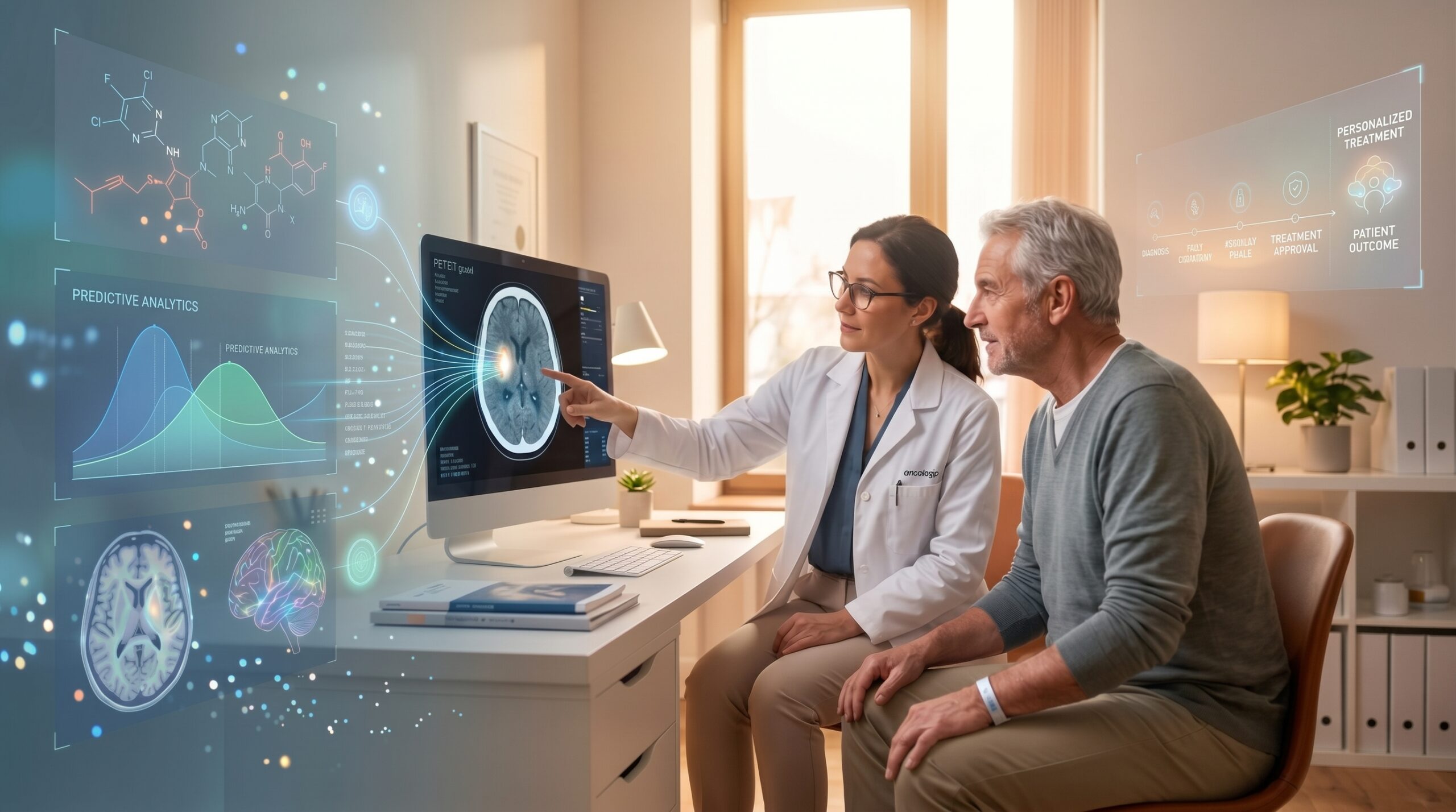
The goal of drug development is to bring the right therapy to the right patient, as reliably and efficiently as possible. But the true reason any of us do this work comes down to two people: the physician who must make the best possible decision, and the patient whose life depends on it.
By grounding interpretation in evidence rather than impression, we strengthen the physician’s decision without ever replacing their judgment. For patients, the impact is profound even when the technology is unseen: faster approvals, smarter enrollment, and therapies that reach the right people sooner.
That is the human meaning of turning imaging into actionable predictions: the right decisions, made sooner, for the person whose life depends on what the scan can reveal.


Do you want to be updated with our news?
By pressing submit you accept the privacy policy and the legal notice of the Quibim website.